
How to Find Contradictions Across Multiple Documents
A practical workflow for locating conflicting dates, obligations, policies, and versions with local AI while preserving the source trail.
The short answer: to find contradictions across multiple documents, search for the same claim in every eligible source, normalize each passage into comparable fields, distinguish genuine conflicts from changes in time or scope, and keep both sides attached to exact evidence. Do not ask an AI tool simply to “tell me which document is right.” Relevance ranking is not authority, and a later date is not always the governing rule.
Contradictions are easy to hide in a fluent summary. A model may choose the passage with the strongest retrieval score, blend two values, or state the newer-looking fact without explaining why. A safer result looks like a conflict register: claim, source A, source B, type of disagreement, authority clues, and unresolved question.
This guide uses three fictional Harborview documents: a services agreement, a later amendment, and an operations memo containing stale procedures. The pack creates several deliberate disagreements while preserving enough context to diagnose them.
| Question | Practical answer |
|---|---|
| Can AI find contradictions automatically? | It can surface candidate disagreements, but a person must verify scope, time, definitions, and authority. |
| Are two different numbers always a contradiction? | No. They may describe different periods, parties, events, units, or versions. |
| Should the model choose the winning source? | Only when the supplied evidence clearly supports a narrow precedence conclusion, and even then, consequential decisions need qualified review. |
| What should a conflict record preserve? | Both passages, filenames, dates, locations, claim fields, authority clues, and the unresolved decision. |
| Why use direct search first? | It exposes competing passages without allowing generated prose to smooth them into one answer. |
Download the contradiction test pack
The documents contain these known tensions:
| Topic | Base agreement | Amendment | Operations memo |
|---|---|---|---|
| Invoice payment | 45 calendar days | Changes to 30 calendar days | Legacy checklist still uses 45 days |
| Security notice | Confirmed incident; 72 hours after confirmation | Suspected or confirmed incident; 48 hours after discovery | Runbook still uses confirmed incident and 72 hours |
| Data export | 90-day export window | Changes to 60 days | Playbook still promises 90 days |
| Convenience termination | 30 days’ written notice | Changes to 60 days | Account summary correctly uses 60 days |
| Service level | 99.5% monthly availability | Expressly unchanged | Memo also says 99.5% |
Not every difference should receive the same label. Between the agreement and amendment, the changed provisions are versioned modifications with explicit precedence language. Between the amended contract and memo, the obsolete procedures are implementation conflicts. The matching service-level values are corroboration, not conflict.
First define what counts as a contradiction
Two passages contradict each other when they make claims that cannot both be true under the same interpretation, time, scope, and authority frame.
That definition rules out many false positives.
Different time
The pilot begins in September and The pilot began in October may reflect a schedule change rather than a logical contradiction. Record the document dates and whether each statement was predictive or historical.
Different scope
Employees receive 20 days and Managers receive 25 days can both be true. Identify population, geography, product, contract, and exception.
Different units or triggers
48 hours after discovery and 72 hours after confirmation differ in both duration and starting event. Comparing only the numbers understates the conflict.
Proposal versus decision
A meeting note may propose a date that an approved plan later rejects. Status words such as draft, proposed, approved, superseded, and effective belong in the claim record.
Governing text versus description
A procedure, email, or summary may disagree with a signed agreement. The disagreement is real operationally even if one record does not modify the other legally.
Before using AI, write the comparison frame:
Same subject?
Same party or population?
Same time period?
Same unit?
Same trigger?
Same status?
Same authority class?
If one field differs, classify before calling the pair contradictory.
Step 1: assemble a deliberate evidence set
Put only the related records in one workspace. Do not mix similarly named projects, clients, policy families, or contract matters. Wait until every intended document is Ready and inspect the extracted text.
For scans, compare OCR with the visible page. Contradiction analysis is unusually sensitive to small errors:
30recognized as80;shallrecognized asshall notor the reverse;1 Junerecognized asI June;- a table row detached from its header;
- a footnote inserted into the wrong paragraph; or
- columns read in the wrong order.
An OCR discrepancy is not a source contradiction. Repair or exclude the bad evidence before comparing claims.
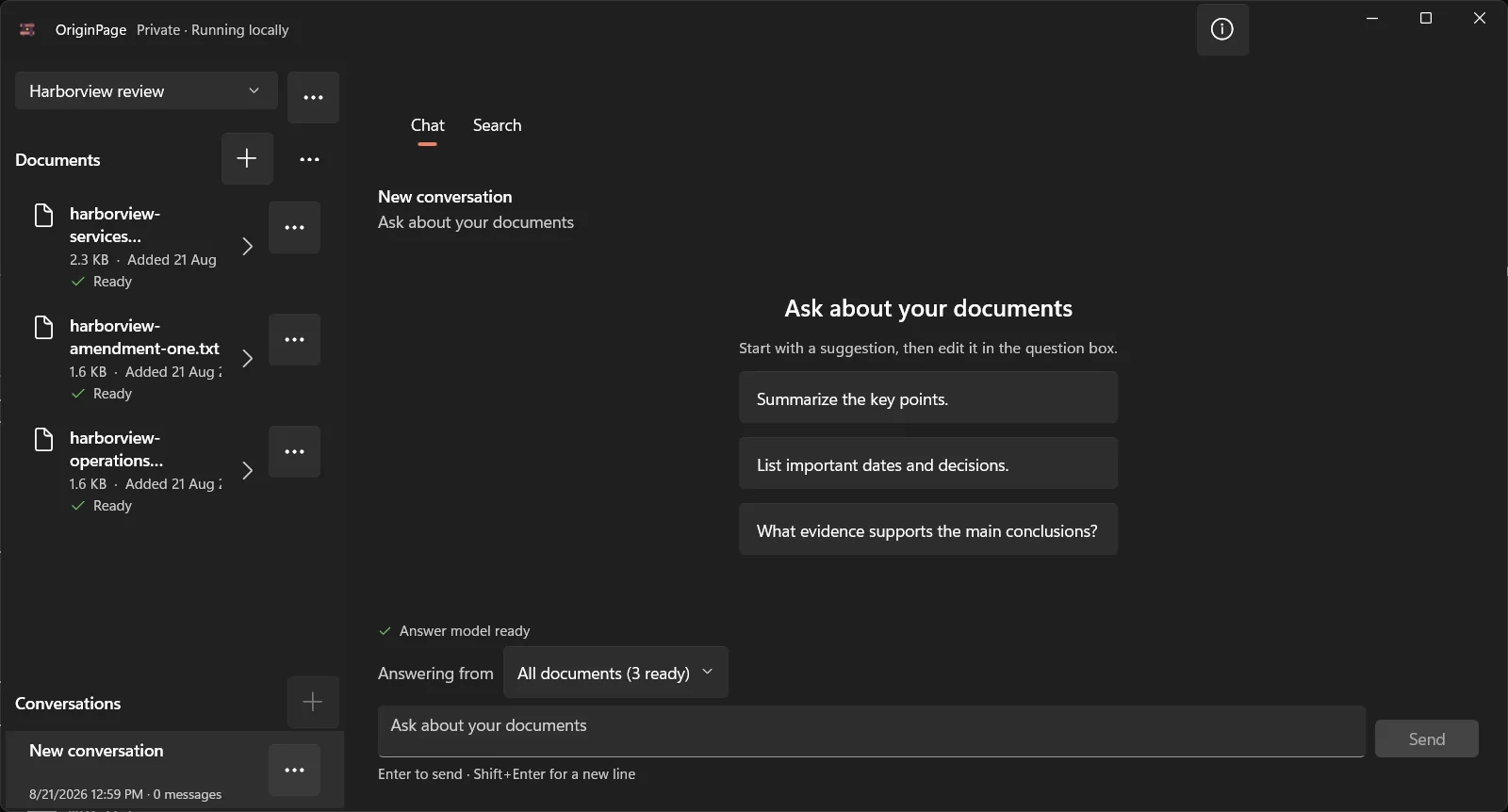
The following real capture shows the exact Harborview agreement, amendment, and operations memo isolated in one workspace and marked Ready.
Step 2: create a claim schema
Do not compare free-form paragraphs if you can compare structured claims. Use fields appropriate to the domain.
For deadlines and obligations:
subject | actor | action | trigger | value | unit | exception | effective date | source statusFor the Harborview security requirement, the normalized claims look like this:
| Source | Actor | Action | Trigger | Value | Scope/status |
|---|---|---|---|---|---|
| Agreement §4 | Supplier | Notify Customer | After confirmation | No later than 72 hours | Confirmed incident |
| Amendment §2 | Supplier | Give initial written notice | After discovery | Within 48 hours | Suspected or confirmed incident; replaces §4 |
| Operations memo | Support team | Notify Customer | After confirmation | Within 72 hours | Existing runbook; memo says revision required |
Once normalized, the conflict is obvious: the amendment changes the trigger, covered incident state, deadline, and communication form. A summary that says only “the documents mention 48 and 72 hours” is not analysis.
Other useful schemas include:
- dates: event, date, timezone, status, as-of date;
- amounts: amount, currency, tax treatment, period, threshold versus actual;
- policies: population, entitlement, eligibility, exception, effective date;
- technical records: system, environment, version, measurement, method;
- research: population, intervention, endpoint, estimate, uncertainty.
Step 3: retrieve candidate passages directly
Search each conflict topic across all eligible documents before asking for synthesis. Start with Hybrid or keywords, then use Exact phrase for confirmation.
For the Harborview pack:
invoice payment days overdue
security incident notice discovery confirmation
Customer Data export after termination
terminate for convenience written notice
service level monthly availability
The goal is coverage, not a final answer. Note every file that contributes and every expected file that does not. Search alternative vocabulary when one source remains absent.
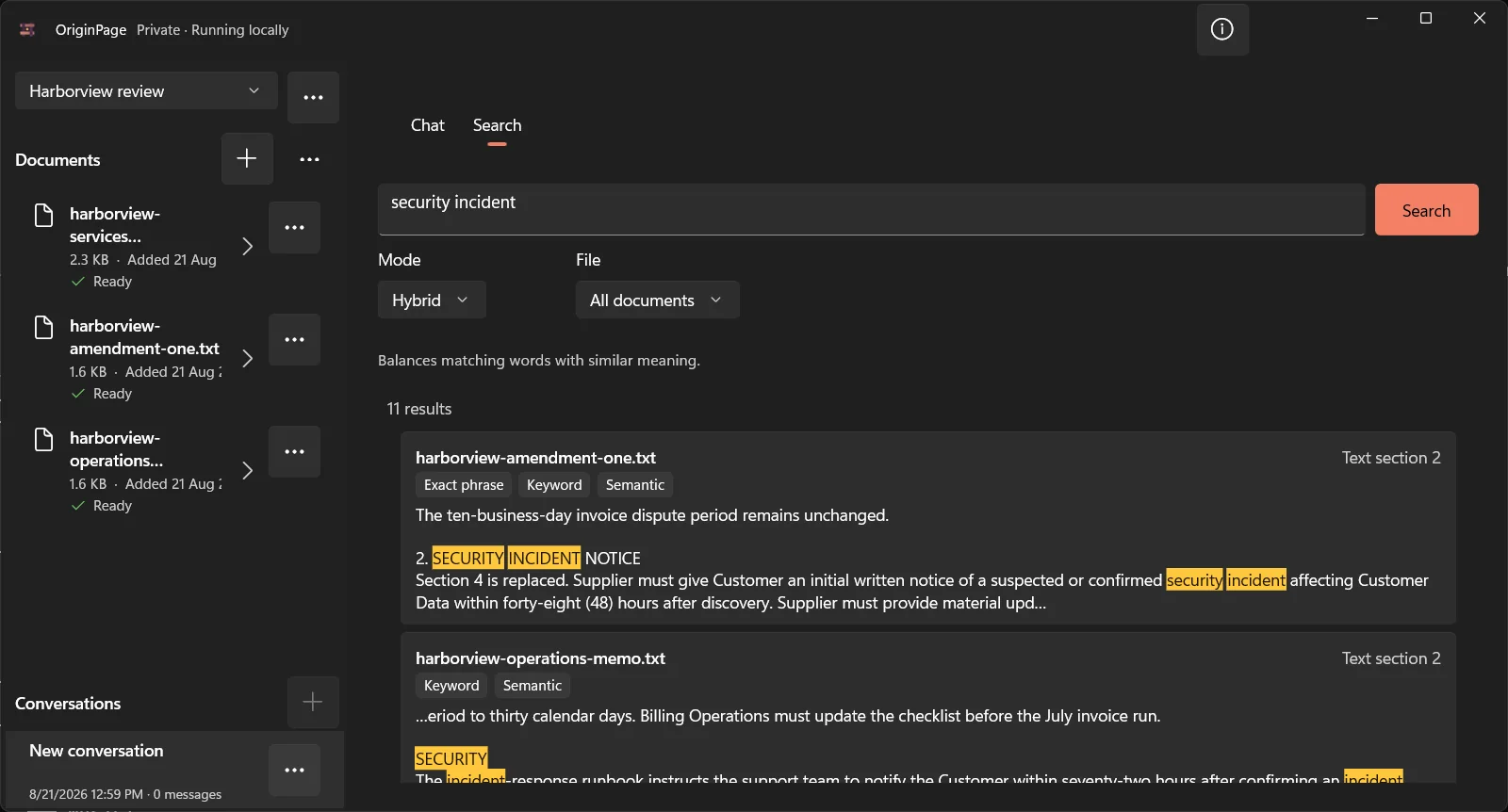
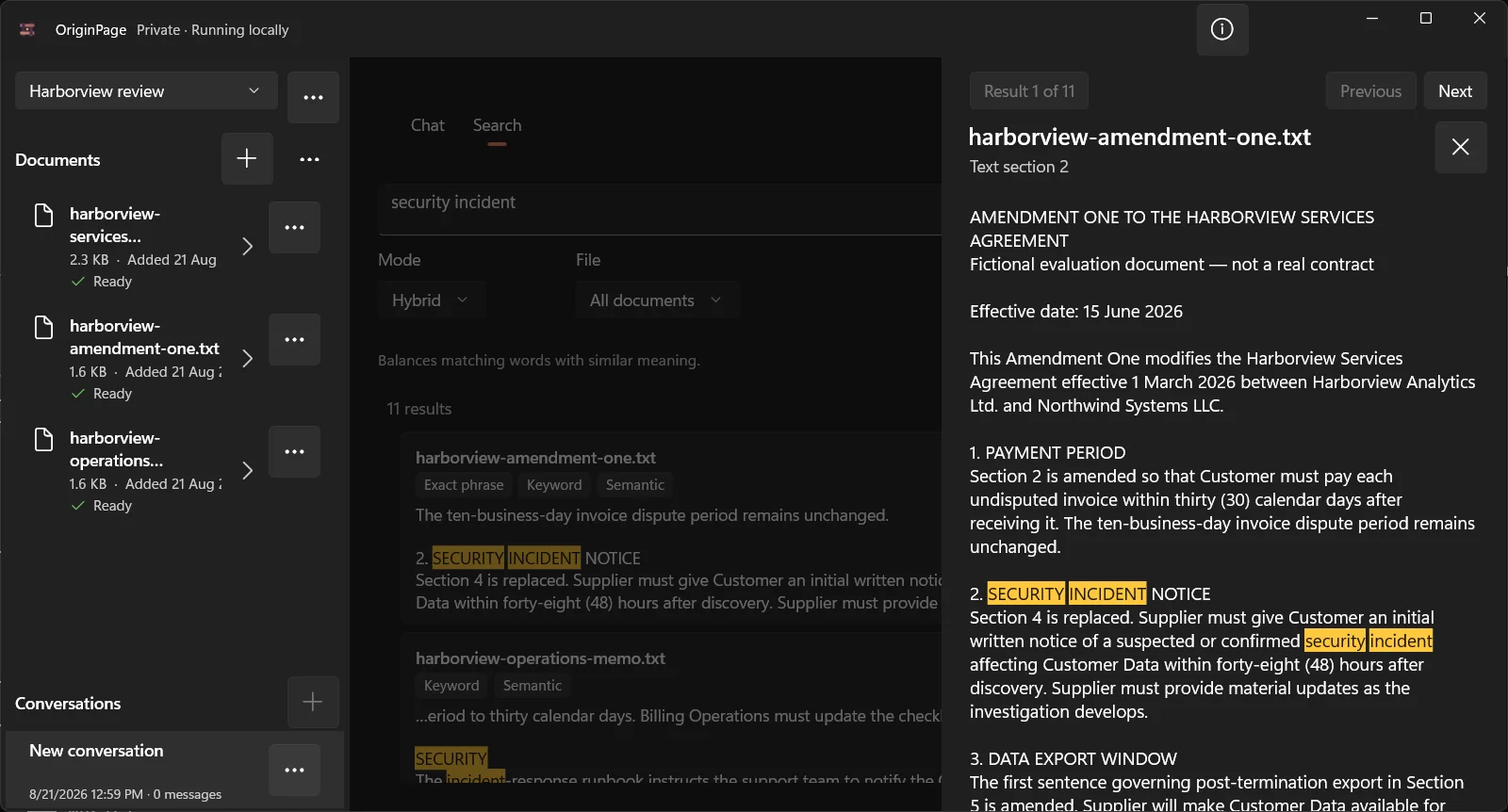
The screenshot below shows one query returning passages from three documents with source identity intact.
If the results are noisy, filter one file at a time. Ask: “What does this record claim?” before asking: “How do the records differ?” That prevents the clearest or most repetitive source from dominating the comparison.
Step 4: separate discovery scope from authority scope
Contradiction discovery often needs all related documents. Authority analysis may need a narrower subset.
For Harborview:
- use all three files to discover inconsistent instructions;
- use the agreement and amendment to establish the apparent contractual change;
- use the memo separately to assess implementation alignment.
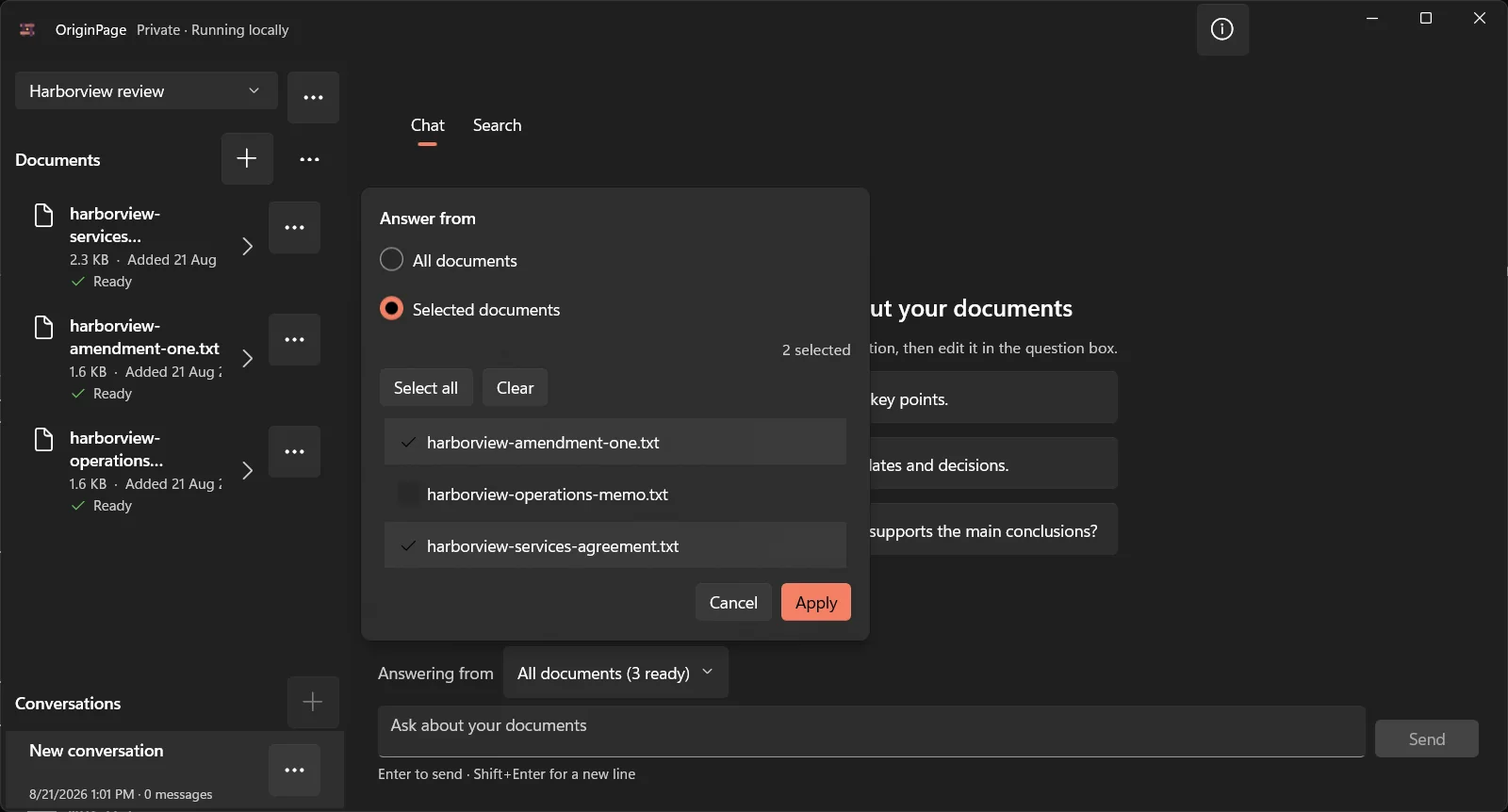
OriginPage’s Answering from control makes the eligible set explicit and retains it with the question.
This distinction also applies outside contracts:
- search every project record for competing launch dates, then scope to approved plans for the official schedule;
- search all policy communications for conflicting instructions, then scope to the current policy for entitlement;
- search every incident artifact for divergent timestamps, then keep each clock and timezone visible rather than selecting one silently.
Step 5: ask for a conflict register, not a verdict
Use a prompt that preserves both sides:
Find candidate disagreements across the eligible Harborview documents.

For each topic, provide:
- source A claim and citation;
- source B claim and citation;
- the fields that differ, including trigger, value, unit, scope, and date;
- whether the difference appears to be a superseding amendment,
  an outdated operational instruction, a scope difference, or unresolved;
- the evidence for that classification; and
- the next question a reviewer must decide.

Do not merge competing values. Do not choose a governing source from filename,
retrieval rank, or recency alone. Write “insufficient evidence” when needed.
The requested output should resemble:
| Topic | Source A | Source B | Classification | Reviewer action |
|---|---|---|---|---|
| Payment period | Agreement: 45 days | Amendment: 30 days | Express modification | Confirm amendment execution and effective date |
| Billing procedure | Amendment: 30 days | Memo: legacy checklist uses 45 | Outdated operation | Update billing checklist |
| Incident notice | Agreement: 72 hours after confirmation | Amendment: 48 hours after discovery | Trigger and deadline modified | Confirm current response process |
| Export procedure | Amendment: 60-day window | Memo: playbook promises 90 | Outdated operation | Update customer-success playbook |
| Service level | All relevant sources: 99.5% | No competing value found | Corroborated | No conflict in supplied corpus |
Notice that the table includes corroboration. If the model reports only disagreements, you cannot tell whether it reviewed the requested non-conflicting topic or simply omitted it.
Step 6: inspect every side of every conflict
Expand the generated answer’s evidence. A two-sided contradiction generally needs at least two supporting passages. If the answer says the payment period changed but cites only the amendment, it has not shown the original value.
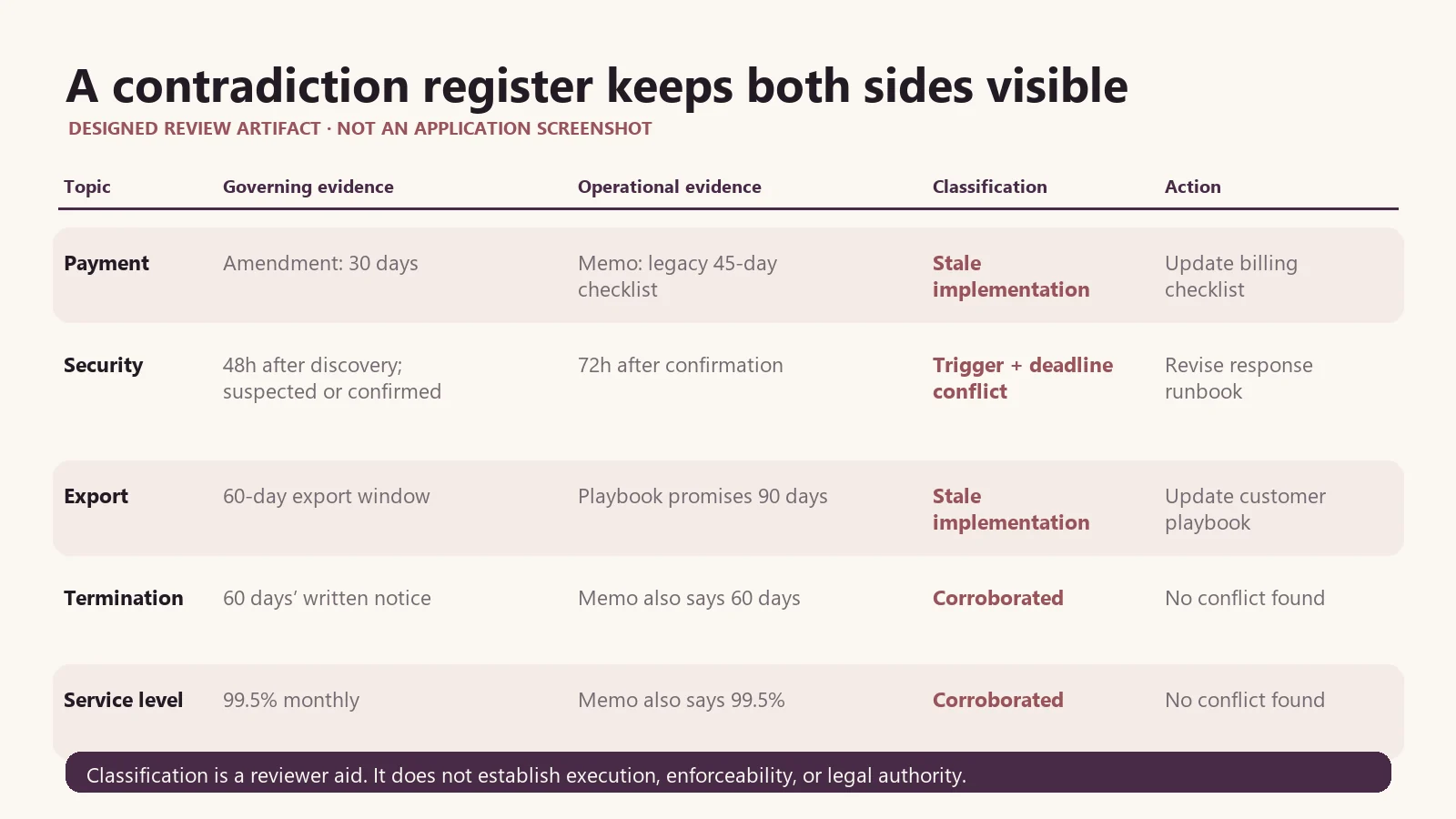
Transfer verified candidates into a conflict register that keeps both passages, the classification, and the required human action visible. The graphic below is an explicitly designed review artifact derived from the Harborview answer key, not an application screenshot.
Audit each row with these questions:
- Does each passage state the compared value directly?
- Are the subject and actor the same?
- Are units and triggers preserved?
- Is one statement merely quoting or criticizing another?
- Does the document label itself draft, final, approved, superseded, or non-governing?
- Are dates publication dates, effective dates, event dates, or metadata?
- Is an exception located just outside the highlighted span?
- Did OCR alter a number or negation?
Open the source context whenever the answer matters. The surrounding heading can turn an apparent contradiction into a proposal, example, historical statement, or exception.
Step 7: classify the disagreement
Use a small taxonomy instead of one generic conflict label.
Direct contradiction
Two sources assert incompatible values for the same claim frame: same event, subject, scope, and time.
Superseding change
A later authorized record expressly modifies an earlier one. Preserve both values and the modification evidence.
Stale implementation
A procedure or summary still reflects an earlier rule. This may create practical risk even when authority is clear.
Scope difference
The values apply to different populations, products, regions, or conditions.
Temporal development
The state changed over time, and both statements may have been accurate when written.
Terminology mismatch
The records may agree but use different labels or levels of precision.
Extraction uncertainty
The apparent disagreement may come from OCR, table reconstruction, or missing pages.
Unresolved
The supplied evidence does not establish why the claims differ or which should control.
Classification keeps the output actionable. A stale checklist needs remediation; a scope difference needs clarification; an unresolved authority conflict needs escalation.
Step 8: run negative and coverage checks
A contradiction search is incomplete until you ask what was not found.
Useful follow-ups include:
Which requested topics had only one supporting source?
Which eligible documents contributed no evidence to this conflict register?
List every number and deadline associated with security incident notice.
Did any source explicitly say that another source was outdated or non-governing?
Which classifications rely on inference rather than express language?
What missing document would be needed to resolve each unresolved item?
Then verify with Direct Search. Search the old value, new value, trigger, and topic separately. If a conflict table lists 60 days, search every occurrence of 60 and sixty in the relevant files. Numbers are easy to compare and easy to attach to the wrong concept.
Also test one topic that should not conflict. In Harborview, the 99.5% service level and liability cap are expressly unchanged. A method that labels every repeated topic as contradictory is not useful.
Step 9: keep an unresolved-conflict ledger
Do not let the generated answer become the system of record. Transfer verified findings into a review ledger with stable fields:
| Field | Purpose |
|---|---|
| Conflict ID | Stable reference for discussion and resolution |
| Normalized claim | The precise proposition being compared |
| Source A and location | First evidence path |
| Source B and location | Competing evidence path |
| Difference fields | Value, unit, trigger, scope, time, or status |
| Classification | Direct, superseding, stale, scoped, temporal, extraction, unresolved |
| Authority evidence | Signature, approval, precedence, effective date, policy status |
| Owner | Person responsible for resolution |
| Decision and rationale | Human resolution, not model inference |
| Verified date | When the sources and decision were checked |
This turns contradiction detection into a managed workflow. The AI helps locate and normalize evidence; a person owns resolution.
Common failure modes
The model silently picks one value
Ask explicitly for every competing value and prohibit a single merged answer. Require citations for each side.
The newest file wins automatically
Recency can be relevant but is not sufficient. A later memo may be less authoritative than an earlier signed instrument.
The result calls every difference a contradiction
Normalize time, scope, unit, trigger, and status first. Many differences are compatible.
One source dominates retrieval
Filter and inspect documents individually. Ask which eligible files supplied no evidence.
A summary quotes another document
An internal memo may repeat an obsolete clause in order to criticize it. Read surrounding context before treating the quotation as the memo’s adopted rule.
The tool hides uncertainty
Require an unresolved category and the missing evidence needed to decide. A neat table should not create false closure.
Search finds no conflict because extraction failed
Inspect retained text, OCR review, page order, tables, and document readiness. Retrieval quality cannot exceed evidence quality.
Privacy considerations for conflict analysis
Cross-document work often involves more sensitive material than one-file chat: contracts, investigations, personnel records, incident reports, customer correspondence, or legal advice. A local workflow can reduce disclosure to cloud providers, but verify the entire pipeline:
- extraction and OCR;
- embeddings and indexes;
- retrieved passages;
- answer generation;
- saved conversations and evidence;
- telemetry and crash reporting;
- backups, synced folders, and exports; and
- removal and retention behavior.
Use synthetic documents when evaluating an unfamiliar product. Do not upload real confidential records merely to learn whether the tool handles contradictions well.
A repeatable contradiction-finding checklist
- Define the exact claim frame before comparing values.
- Isolate the related matter or policy family.
- Confirm all intended documents are Ready.
- Review OCR and extracted text around critical claims.
- Record source title, date, status, and authority class.
- Search the topic across all eligible sources.
- Filter each source and state its claim independently.
- Normalize actor, action, trigger, value, unit, exception, time, and scope.
- Request a conflict register rather than a winning answer.
- Require evidence from every side.
- Classify direct, superseding, stale, scoped, temporal, extraction, or unresolved differences.
- Check at least one topic expected to agree.
- Ask which sources and topics contributed no evidence.
- Open the full context for every consequential conflict.
- Assign human ownership for resolution.
Separate a contradiction from missing evidence
“No supporting passage retrieved” and “the documents disagree” are different findings. To record a contradiction, retain two attributable propositions that cannot both hold under the same conditions. If one document is silent or extraction is incomplete, record a gap. If dates, populations, or definitions differ, record the difference before deciding whether it is a conflict.
Method note
The Harborview contradiction pack was created on 19 August 2026 as a synthetic teaching fixture. The expected findings were derived directly from the published text files and are not presented as an undisclosed model benchmark. Figures 1–3 and 5 were captured from OriginPage 1.0.23.0 on Windows 11 on 21 August 2026 using those exact files; Figure 4 is explicitly designed from the same source text. No real customer, employee, legal, or incident data was used or uploaded.
Start with How to Compare Two Contracts With AI Without Uploading Them for a two-instrument workflow. If the collection is primarily Word files, first follow the guide to searching across multiple DOCX documents offline. Use Why Ctrl+F Sometimes Beats AI and When It Doesn’t to choose the retrieval method for each claim. For more on support and uncertainty, see A Citation Is Not Enough.
Try OriginPage free for seven days through Microsoft Store if your work depends on finding disagreements without losing the source trail. A one-time purchase is required to continue after the trial.