
Review research papers locally without losing source context
Build a source-attributed literature matrix from local papers. Separate reported results from interpretation, check extraction, and preserve limitations.
When several papers discuss the same topic, a smooth summary can hide differences in population, method, and outcome. A useful local review keeps those differences visible and ties each statement to the paper that supports it.
OriginPage can search and compare imported documents. It does not provide a comprehensive literature search, validate peer review, or determine whether a reported result is sound. This workflow begins with a collection you have already chosen and are permitted to process.
Define the review question and collection
Write one research question before importing files. “What do these papers report about retrieval failures on long documents?” is easier to evaluate than “Summarize everything about AI.” Keep a separate inclusion log with the title, publication version, date, persistent identifier, and reason for including each source.
Prefer identifiable filenames and avoid importing the same preprint and published version as though they were independent studies. Record corrections and retractions in your reference workflow; a locally stored PDF will not update itself.
Inspect extraction before interpreting results
After the files are Ready, inspect a representative method paragraph and result passage. Check multi-column reading order, mathematical symbols, captions, and table cells against the original PDF. OCR review is especially important where a missing minus sign, unit, or negation changes the meaning.
Search for a distinctive technical term first. If it appears in the original but not in extracted text, do not infer that the paper did not discuss it. Resolve the extraction problem or inspect that section manually.
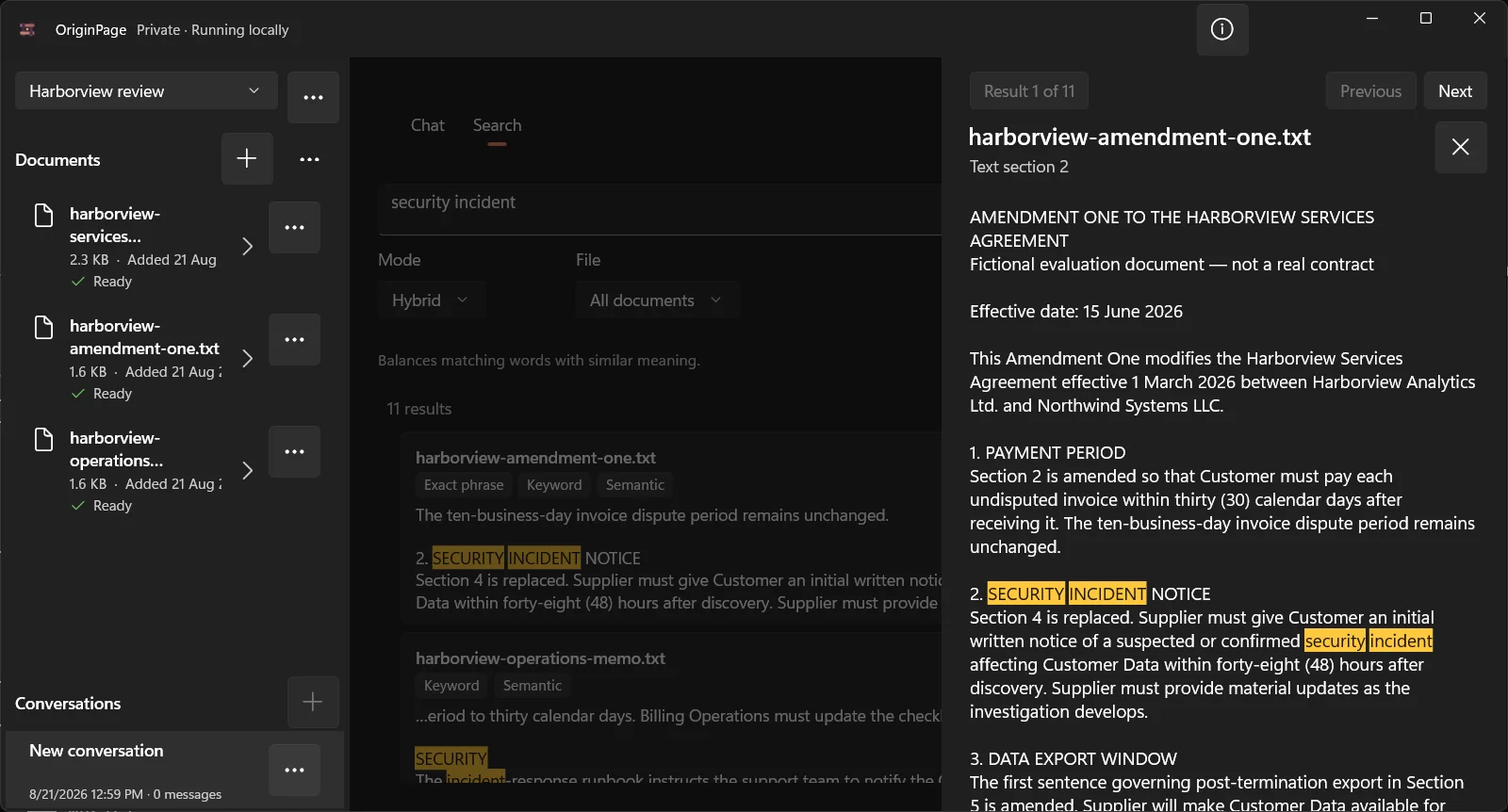
This contract-based interface example shows how to inspect surrounding source text. It is not a research-paper result or evidence that equations and tables are extracted perfectly.
Build a matrix before writing a synthesis
For each paper, record:
| Field | What to preserve |
|---|---|
| Question | The question the authors actually investigated |
| Setting | Population, dataset, task, or experimental conditions |
| Method | Intervention, comparison, and relevant assumptions |
| Result | Reported outcome, units, and uncertainty |
| Limits | Exclusions, caveats, and threats to validity |
| Evidence | Exact source location checked in the original |
Ask one paper at a time for the initial row. Then select two or three papers to compare a particular field. A useful prompt is:
Compare the selected papers’ evaluation settings and stated limitations. Attribute every finding. Separate the authors’ measured results from their interpretations. Do not combine incompatible metrics into a single ranking.
An absent answer is not evidence that a paper lacks a limitation. Search the discussion, methods, and appendix directly, and mark the field unresolved if you cannot verify it.
Preserve disagreement in the synthesis
Two results can differ because the studies tested different things. Before describing a contradiction, compare datasets, time periods, outcome definitions, baseline methods, and uncertainty. Keep “the authors report” separate from your conclusion about generalizability.
Use your citation manager or editorial process for bibliography formatting and persistent links. A retained passage in a local application is helpful during review, but it does not replace a complete scholarly reference or an original page locator.
Close with a reproducible review record
Save the collection version, review question, matrix, and unresolved issues in an approved location. Check every quantitative claim in the final prose against the original, including denominator and units. Have a relevant subject-matter reviewer assess substantive conclusions where needed.
If the collection is confidential or unpublished, evaluate device access and backups as well as the processing location. For a small source-checking exercise, start with the PDF reading test. For the architecture question, read long context versus retrieval.