
OriginPage vs Open WebUI and Ollama: desktop reader or managed service?
Compare a fixed Windows document workflow with a configurable self-hosted knowledge service, including deployment responsibility and source verification.
Choose the deployment shape first. OriginPage is a Windows desktop document reader for one local user. Open WebUI with an appropriately configured model service such as Ollama can support a broader, administered knowledge workflow. The latter gives you more deployment choices and more configuration to account for.
Knowledge management is a real feature
Open WebUI documents knowledge bases, nested directories, file management, and synchronization of local directories. Its current documentation explains that ordinary retrieval spans the knowledge base; organizing files into subdirectories does not by itself create separate retrieval indexes. Knowledge documentation
For a sensitive collection, distinguish organization from authorization and retrieval scope. A folder name is not enough to establish who can access the contents or what a question can retrieve.
Compare responsibilities
| Decision | Open WebUI deployment | OriginPage |
|---|---|---|
| Models and services | Record your configured model, embedding, extraction, and network services. | Fixed packaged model stack. |
| Users | Assess authentication and permissions for the chosen deployment. | Local Windows user workflow; no team administration. |
| Documents | Configure the knowledge collections and verify retrieval behavior. | Managed Documents within separate Workspaces. |
| Operations | Own service updates, configuration, backups, and exposed endpoints. | Own endpoint protection and local data handling; Store servicing is separate. |
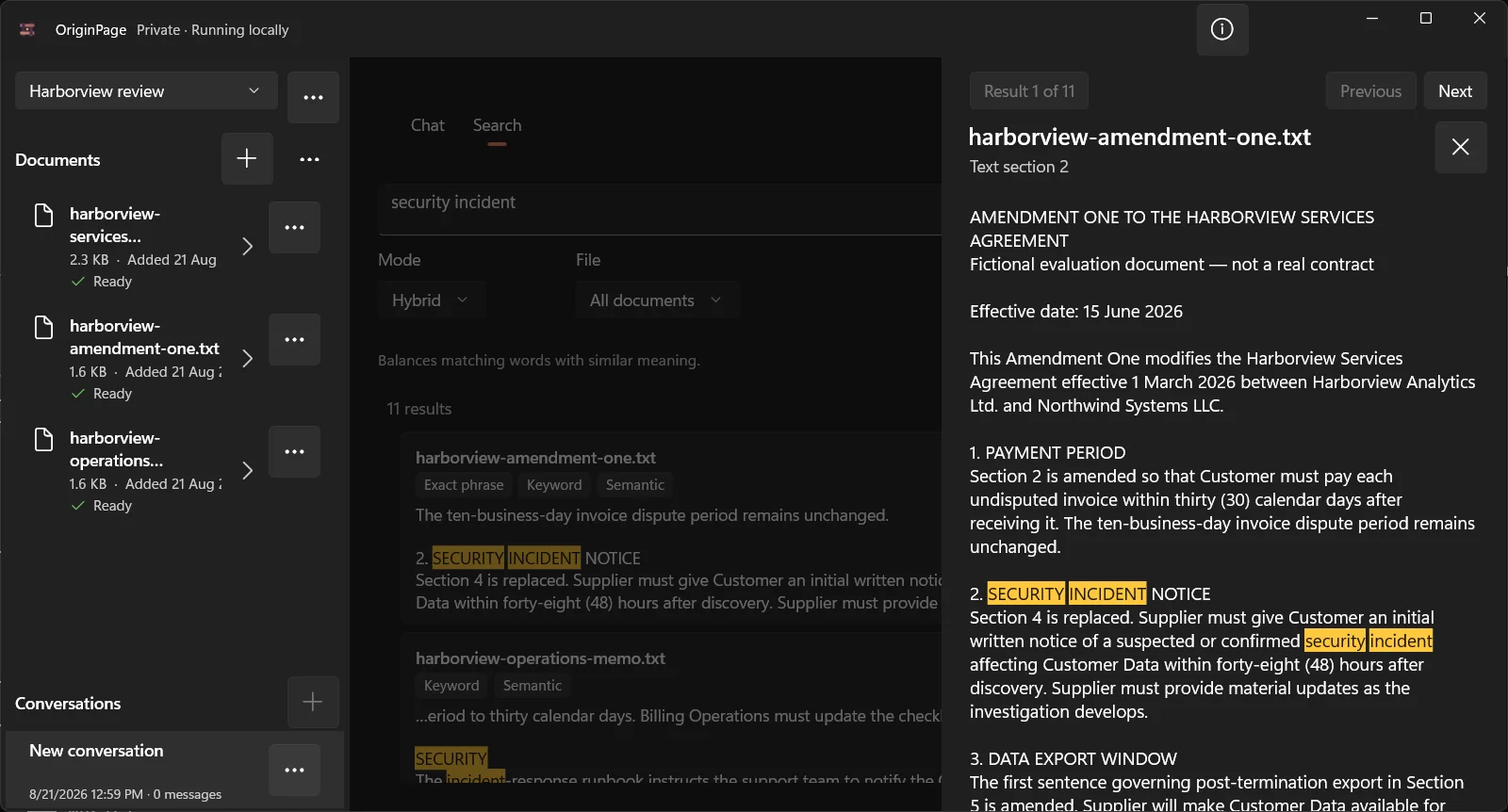
OriginPage takes a fixed approach: PDF, TXT, and supported DOCX import on Windows 11 x64, reviewed English OCR for PDFs, four Direct Search modes, per-question document selection, and retained evidence passages. It does not provide cloud collaboration, model switching, a server API, or a general agent platform. See the capability guide and privacy boundary.
OriginPage uses an App, Core Worker, and Inference process tree. It is not a single-process security sandbox, and process separation does not defend against software already running with the user’s authority.
Test the configured system
“Self-hosted” does not specify where every provider runs. Trace extraction, embeddings, generation, optional tools, and update traffic for your configuration. A local model endpoint alone does not establish that the rest of the pipeline stays local.
Use a known clause and a deliberately absent fact. Check the passage behind the answer, the collection searched, and how unsupported questions are handled. Repeat after changing a provider or retrieval setting; those changes can affect results.
Which workflow fits?
Evaluate Open WebUI when managing a configurable service or shared knowledge environment is part of the job. Evaluate OriginPage when the requirement is its narrower, fixed desktop workflow. Do not infer that one is safer or more accurate solely from the number of processes or installation steps.
How this comparison was prepared
The OriginPage team publishes this article and sells OriginPage. We reviewed the linked first-party documentation on September 20, 2026. This is a documentation-based comparison, not a hands-on benchmark. Screenshots illustrate OriginPage only. We have not measured comparative speed, memory use, extraction quality, or answer accuracy. A feature not established by a source is a question to test, not proof that the feature is absent.
Use the fictional PDF reading test with each candidate. Check one known fact, an exception, a scanned page, and a question the files cannot answer. Record the version, model, settings, source returned, and any misses before choosing a tool.