
Compare draft patent claims with a local reference collection
Build a source-linked claim-element review using fictional references, while distinguishing a local document comparison from a patentability or novelty opinion.
A local reference comparison can show where a supplied document discusses a claim element. It cannot establish that a search is exhaustive, determine the prior-art status of a reference, or decide patentability. Keep those decisions separate from passage retrieval.
The question this exercise answers
The Novalis pack contains an invented draft, two fictional reference excerpts, and a counsel memo. The reference identifiers are teaching labels, not actual patent publications. Begin with one reference at a time so a missing element is not silently borrowed from another.
Download the fictional records
Download the separate records as a ZIP, extract it, and import the TXT files individually:
- Record 1: Unfiled provisional patent specification & draft claims (excerpt)
- Record 2: Prior art reference a — fictional reference a (excerpt)
- Record 3: Prior art reference b — fictional reference b (excerpt)
- Record 4: Inventor interview & patent counsel legal memorandum
The combined reading copy remains available. Import either the separate files or the combined copy, not both. Question Scope selects whole imported Documents; headings such as “Record 1” inside a single TXT file cannot be selected independently. Use the separate files for this walkthrough.
These are fictional teaching records, including any future dates, statute references, and professional opinions. They are not authentic filings, standards, advice, or a benchmark of OriginPage’s answer quality.
Locate the passages before asking for a comparison
Create a separate Workspace for the exercise. Import the individual records and wait for each to show Ready. Open Document details and check the retained text. These TXT exercises do not demonstrate PDF layout extraction or OCR.
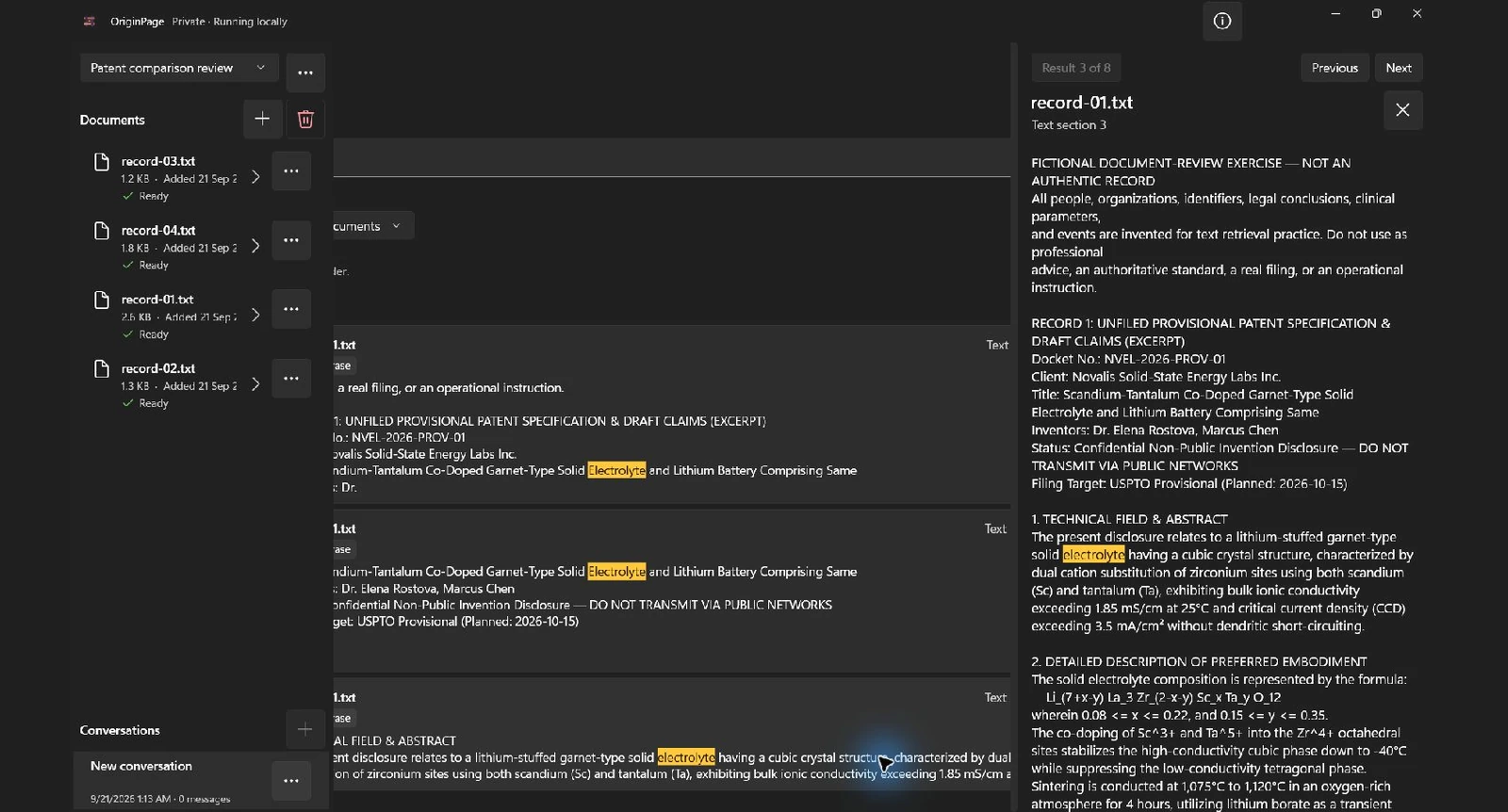
In Search, try electrolyte in Exact phrase mode, without adding quotation marks. Search each relevant file as well as the collection. If wording differs, try Keyword or Hybrid and inspect the returned passages. A missing result is a reason to check wording, scope, and extraction—not proof of absence.
Choose the records allowed to answer
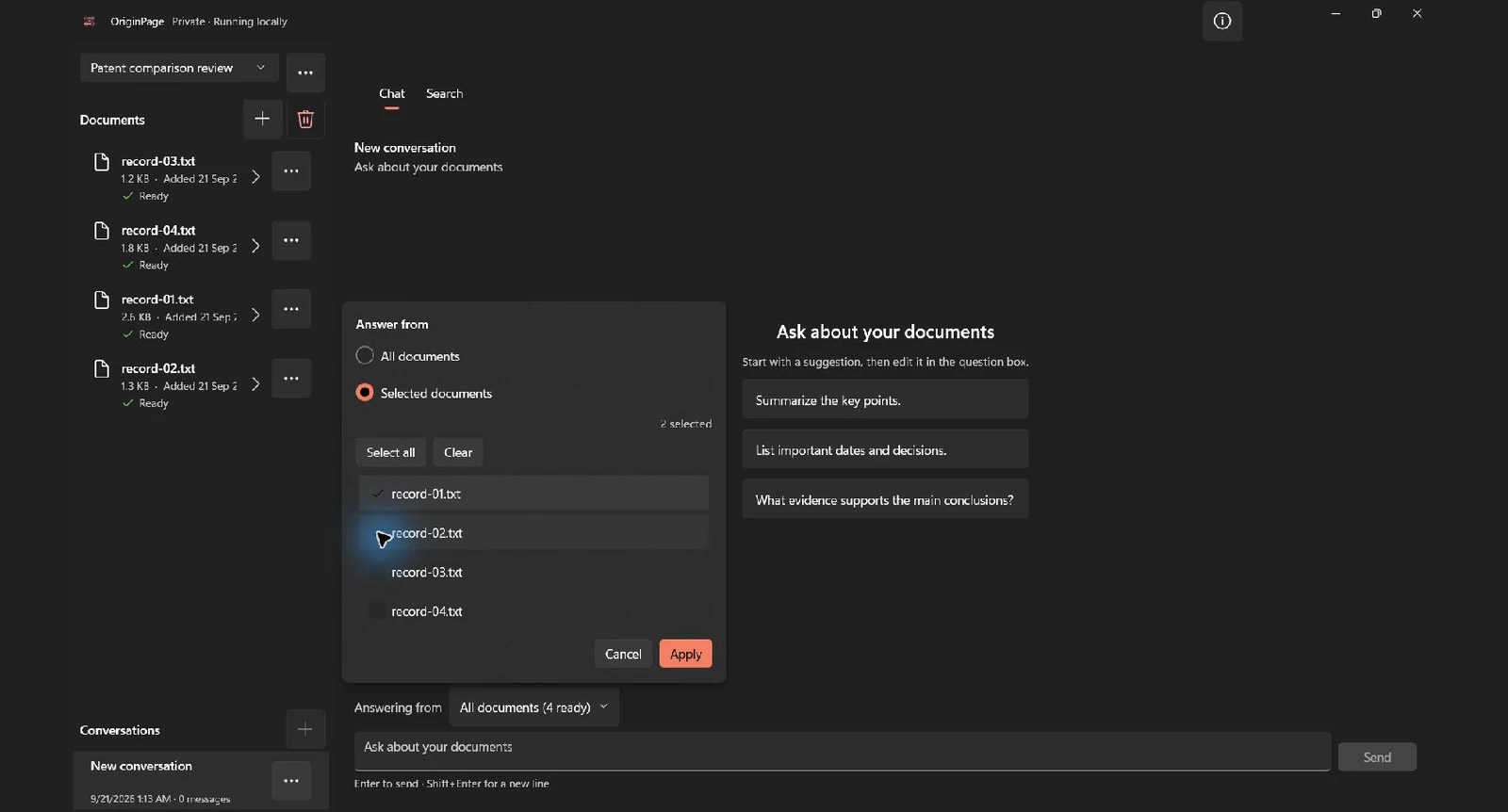
Select record-01.txt and record-02.txt for the first comparison. Repeat with record-01.txt and record-03.txt before adding the memo. In Chat, use Answering from → Selected documents. Search filters and Question Scope are separate controls; setting one does not set the other.
Try this focused question:
Map each stated draft claim element to an explicit passage in the selected reference. Use “not located in this supplied excerpt” when support is missing. Do not combine references or give a novelty or obviousness opinion.
Check the result against the source
The following is an editorial answer key derived from the fictional files, not a recorded model response. Answers may omit relevant evidence; use Direct Search and the original records to complete the review.
| Review stage | Record boundary | Expected artifact |
|---|---|---|
| Reference A | Draft plus record 2 | Element-to-passage table, including missing support. |
| Reference B | Draft plus record 3 | Separate table using only that reference. |
| Memo review | Add record 4 | Attributed interpretations and a list of further questions. |
A feature not retrieved is not necessarily absent from the complete reference. Inspect the full document and drawings in the appropriate tools, verify publication and priority information, and distinguish a technical resemblance from a legal conclusion. OriginPage does not search patent databases or interpret drawings as a general vision system.
Keep a review record
Record claim element, reference identity, exact passage, figure or section to inspect separately, uncertainty, and reviewer decision. Keep invented labels out of real filings and verify any actual citations independently.
When a question needs two sides, open evidence from both. Check the filename, retained passage, surrounding conditions, and the original source where layout matters. A saved citation supports inspection; it does not certify the source or the conclusion.
Processing and professional boundaries
Do not assume every cloud upload is a public disclosure, or that local processing automatically preserves patent rights. Assess confidentiality, access, foreign processing, and filing obligations with responsible counsel. The USPTO has issued practitioner guidance on AI use. USPTO practitioner materials
OriginPage processes supported documents locally during ordinary use. The privacy statement explains the limits, including Windows services and local account access. For formats and supported behavior, see what OriginPage supports.
Method
Revised September 21, 2026. The two screenshots show the downloadable fictional records imported separately into the locally installed OriginPage 1.0.35.0 candidate. We ran the stated Exact phrase query, opened the shown source passage, and applied the illustrated Selected documents scope. These captures demonstrate retrieval and scope, not generated-answer quality or professional validation. The source inspector clips part of the main pane in this candidate; the screenshots preserve that observed layout. The exercise findings are an editorial answer key, not a captured model response.