
Review commercial lease terms and rent-roll assumptions offline
Compare fictional leases and an acquisition memo to trace CAM caps, consent requirements, and co-tenancy assumptions back to their sources.
A rent-roll assumption is not a lease term. Review the executed documents and amendments first, then ask whether the model and diligence memo reflect them. Local search helps locate the relevant wording without uploading the deal files.
The question this exercise answers
The Westlake exercise pairs two different tenant leases with an acquisition memo. Keep each tenant’s terms separate: a cap in one lease cannot be applied to another tenant merely because both occupy the same property.
Download the fictional records
Download the separate records as a ZIP, extract it, and import the TXT files individually:
- Record 1: Master commercial lease agreement (excerpt)
- Record 2: Satellite retail lease agreement (excerpt)
- Record 3: Acquisition audit memorandum & rent roll reconciliation
The combined reading copy remains available. Import either the separate files or the combined copy, not both. Question Scope selects whole imported Documents; headings such as “Record 1” inside a single TXT file cannot be selected independently. Use the separate files for this walkthrough.
These are fictional teaching records, including any future dates, statute references, and professional opinions. They are not authentic filings, standards, advice, or a benchmark of OriginPage’s answer quality.
Locate the passages before asking for a comparison
Create a separate Workspace for the exercise. Import the individual records and wait for each to show Ready. Open Document details and check the retained text. These TXT exercises do not demonstrate PDF layout extraction or OCR.
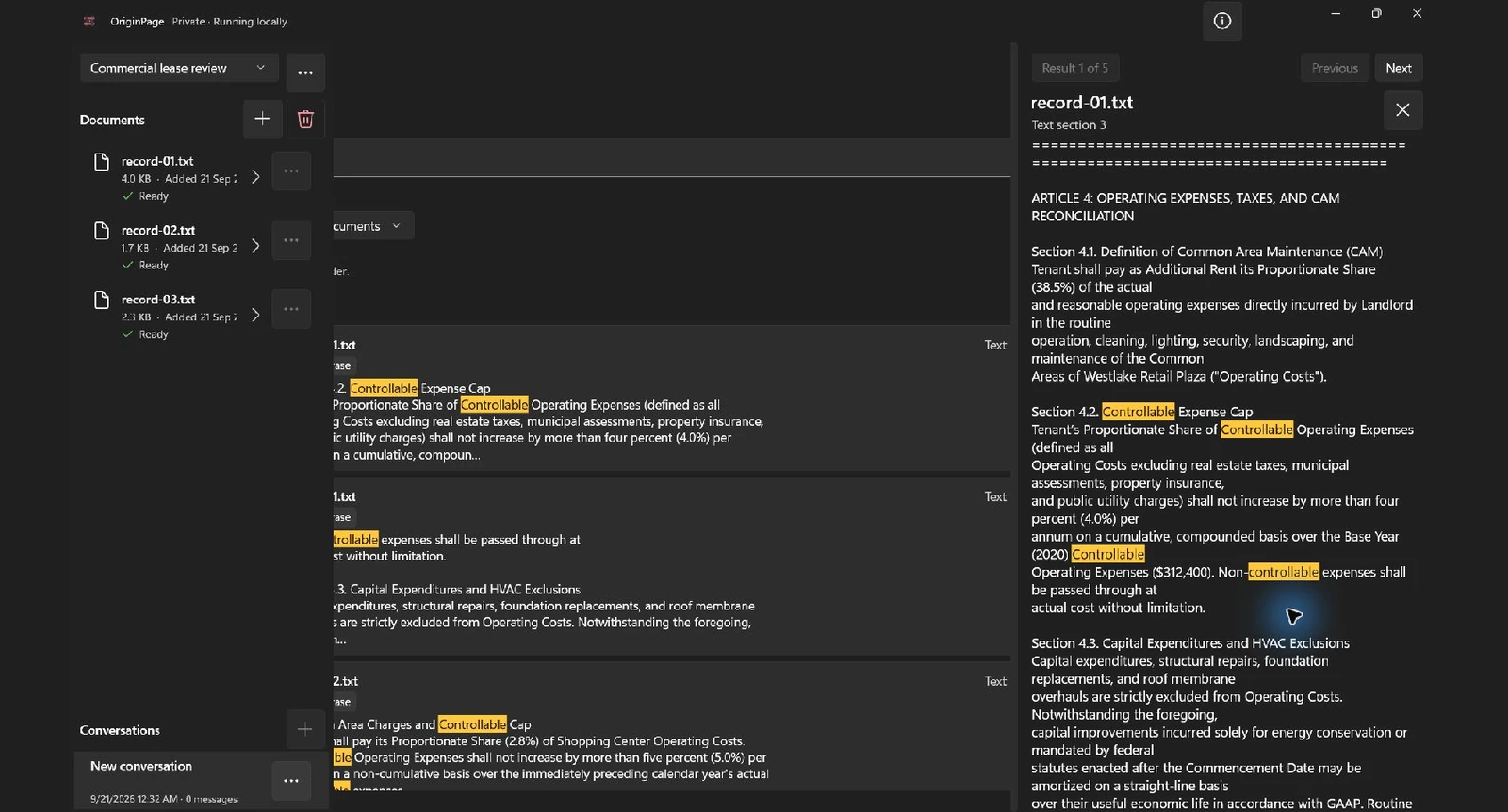
In Search, try controllable in Exact phrase mode, without adding quotation marks. Search each relevant file as well as the collection. If wording differs, try Keyword or Hybrid and inspect the returned passages. A missing result is a reason to check wording, scope, and extraction—not proof of absence.
Choose the records allowed to answer
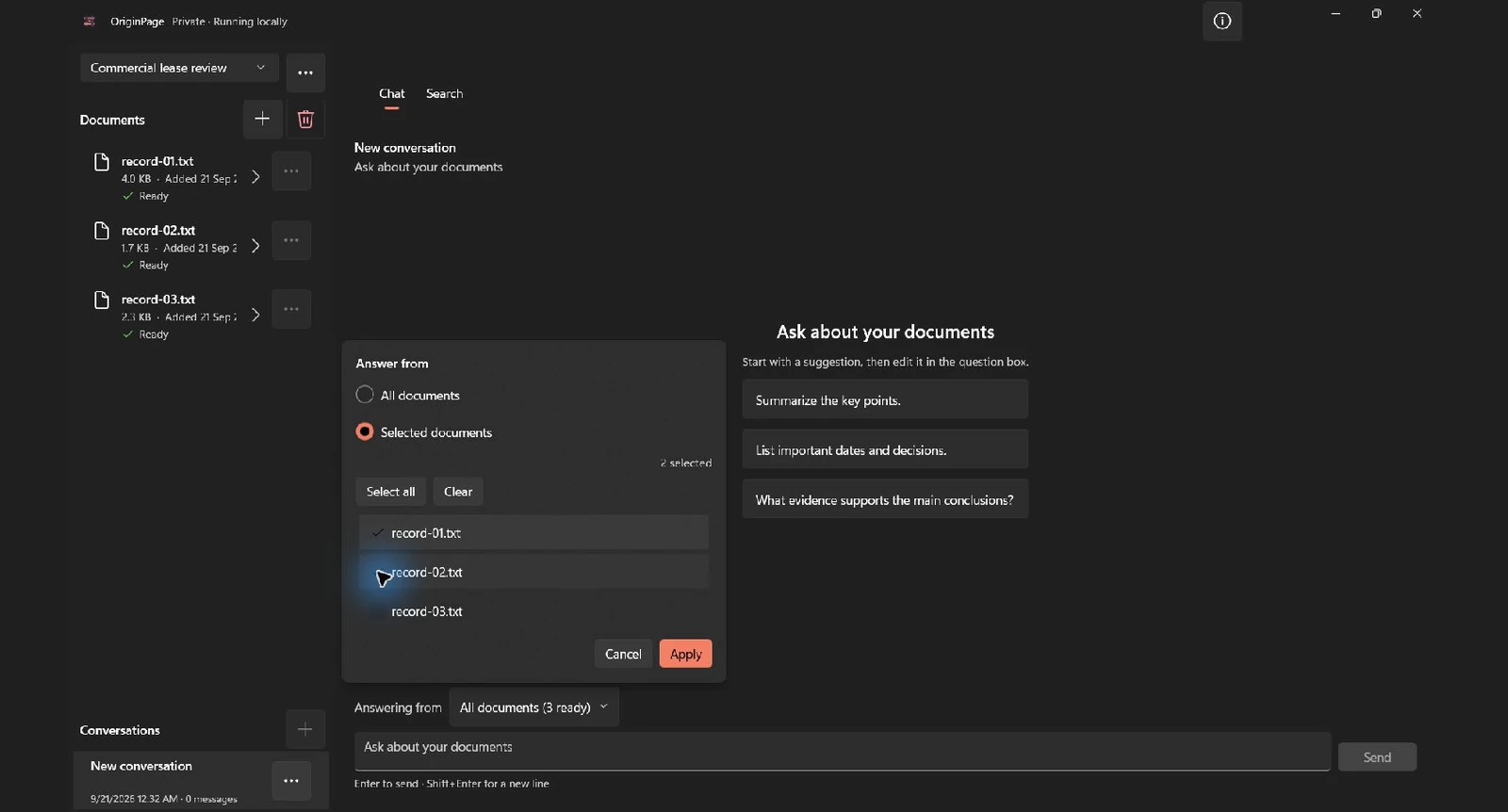
Select record-01.txt and record-02.txt to compare lease caps. For the anchor tenant’s co-tenancy terms, use record-01.txt and record-03.txt. In Chat, use Answering from → Selected documents. Search filters and Question Scope are separate controls; setting one does not set the other.
Try this focused question:
Compare the controllable operating expense caps in the two leases. Give the tenant, percentage, base year, and whether the cap is cumulative or non-cumulative. Cite each lease; do not calculate a recovery.
Check the result against the source
The following is an editorial answer key derived from the fictional files, not a recorded model response. Answers may omit relevant evidence; use Direct Search and the original records to complete the review.
| Item | What to verify in the fictional pack |
|---|---|
| Anchor cap | Record 1 states a 4.0% cumulative, compounded cap tied to a 2020 base year. |
| Billed repair | Record 3 reports a disputed $48,200 HVAC charge; compare its account with record 1, section 4.3. |
| Co-tenancy | Compare record 1, section 11.2, with the memo’s description of the other anchor’s operations. Do not infer that every trigger has occurred. |
The memo supplies assertions about billing and occupancy, not the underlying invoices or a current inspection. Request those records before treating an alleged discrepancy as established. Compute caps, proportions, and arrears in a spreadsheet using verified inputs.
Keep a review record
Use an exceptions schedule containing tenant, clause, model assumption, source evidence, missing document, reviewer, and status. Preserve the trigger, notice requirement, remedy, and effective date together.
When a question needs two sides, open evidence from both. Check the filename, retained passage, surrounding conditions, and the original source where layout matters. A saved citation supports inspection; it does not certify the source or the conclusion.
Processing and professional boundaries
Check data-room terms before making managed local copies. This exercise is document comparison, not a legal opinion on enforceability or an appraisal of the property.
OriginPage processes supported documents locally during ordinary use. The privacy statement explains the limits, including Windows services and local account access. For formats and supported behavior, see what OriginPage supports.
Method
Revised September 21, 2026. The two screenshots show the downloadable fictional records imported separately into the locally installed OriginPage 1.0.35.0 candidate. We ran the stated Exact phrase query, opened the shown source passage, and applied the illustrated Selected documents scope. These captures demonstrate retrieval and scope, not generated-answer quality or professional validation. The source inspector clips part of the main pane in this candidate; the screenshots preserve that observed layout. The exercise findings are an editorial answer key, not a captured model response.